The Code Beyond the Rulebook: How Tea, Tact and a Firm Handshake Still Govern English Club Hockey
Every hockey club in England owns at least one copy of the rules. It sits in a kit bag, or on a shelf in the clubhouse, or in the mind of the umpire who has been officiating since before the current squad was born. It covers sticks, feet, dangerous play and the precise circumstances in which a green card becomes yellow. What it does not cover is the other set of rules: the ones nobody writes down, nobody votes on, and everybody knows.
In 2026, English club hockey is more professional in its presentation than ever. Fixtures are published online, performances are clipped for analysis, and pitch bookings are managed through apps that would have seemed fanciful a generation ago. Yet the culture of the club game still rests on a code that is passed down by observation rather than instruction. It is a code built around tea, apologies and the end-of-match handshake, and it remains one of the sport's quiet strengths.
The First Law: The Tea Rota Is Sacred
Ask a club member what makes a Saturday work and they will rarely begin with tactics. They will begin with the urn. The provision of tea after a match is, in most clubs, an obligation written into the fixture arrangements. The unwritten part concerns who actually makes it, who carries it out, who washes up, and how quickly the away team is invited to help themselves.
The conventions vary from club to club but the principles are consistent. The home side takes the lead. Juniors are expected to learn the routine without being asked twice. The captain checks that the opposition has been offered a drink before the first biscuit disappears. And the person who quietly volunteers for tea duty every week is, in a real sense, the spine of the club. They are not usually the highest scorer. They are the reason the highest scorer has somewhere to sit afterwards.
In an era when clubs are anxious about membership retention, the tea rota is not a trivial matter. It is the first social contact a new player has with the club after the final whistle. A warm drink and a plate of something plain can do more for retention than a glossy recruitment poster.
The Apology Economy
Hockey is a game of deflections. A ball clips a stick and loops over a defender. A shot flicks off a foot and wrong-foots a goalkeeper. A pass hits someone on the ankle at close range. The rulebook deals with the consequences. The code deals with the reaction.
The apology is the currency of these moments. A raised hand and a brief "sorry" acknowledges that the outcome was accidental and that the opponent is not merely an obstacle. The sincere apology for a ball that has flown up unexpectedly is part of the game's basic courtesy. So is the apology for a misplaced pass, offered before anyone else has a chance to comment.
There is also an etiquette of receiving an apology. The expected response is a nod, a wave, or a short "no problem". Prolonging the moment, or using it as an opportunity for commentary, breaks the code. The apology is not an admission of weakness. It is a reminder that the two teams are engaged in the same activity and that everyone has to get home afterwards.
Umpires notice this. A player who apologises for an accidental collision and then gets on with the game is easier to manage than one who disputes every contact. The code and the rulebook are not in conflict. They support one another.
The Handshake and the Queue
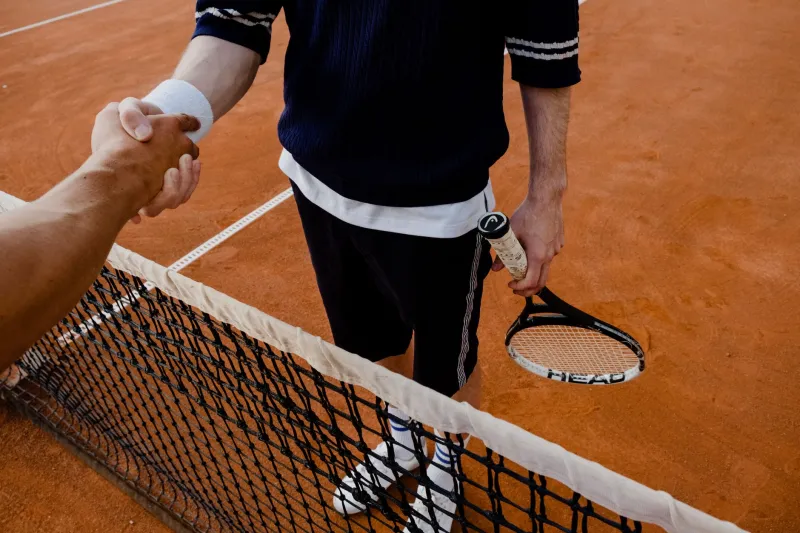
The end-of-match handshake is the most visible part of the code and the most easily taken for granted. Players line up, sticks are tapped or held aside, gloves come off, and hands are shaken. The order matters less than the fact that it happens. The opposition is thanked. The umpires are thanked. The tea volunteers, if they are present, are thanked.
In 2026, the handshake survives despite the pace of modern life. Players have trains to catch, families to return to, and match footage to review. The handshake takes less than a minute. Its value is disproportionate. It marks the transition from contest to community. It gives the losing side a dignified exit and the winning side a reminder that victory is temporary.
The queue for the handshake also has its own conventions. The captain usually leads. Younger players follow. The umpires are often last, which gives them a moment to leave the pitch without being drawn into prolonged discussion. It is a small piece of choreography, repeated every weekend across England, and it works.
Borrowed Kit and the Honour System
Club hockey runs on borrowed kit. A player forgets shin pads. Another has a stick that is too short. A goalkeeper needs a spare glove. The code governs these transactions. You ask politely, you return promptly, and you return it clean. If you borrow a stick and it breaks, you offer to replace it. If you borrow a sock, you wash it before it goes back into the bag.
There is no formal ledger for these exchanges. The club's lost property box is a monument to those who have broken the code. The honour system works because most people respect it, and because the consequences of not respecting it are social rather than financial. A reputation for returning kit is worth more than a spare pair of socks.
Calling Your Own
The code extends to honesty in the moment. A player who knows the ball came off their foot will often raise a hand before the umpire blows. A player who has committed a stick tackle may admit it. This is not naive. It is a recognition that the game depends on a degree of self-regulation, especially at levels where neutral umpires are scarce.
Calling your own does not always change the decision. It does change the atmosphere. It signals that the player is treating the umpire as a partner rather than an adversary. In a sport where umpire numbers remain a concern, that signal matters.
Why the Code Still Matters in 2026
English club hockey is changing. Pitches are busier, schedules are tighter, and the administrative burden on volunteers is heavier than many members realise. The unwritten code will not solve those problems. It will not find new umpires or free up extra pitch slots. But it does something equally important. It makes the club a place people want to return to.
The rulebook tells players what is a foul. The code tells them what is fair. The rulebook sets the duration of the match. The code sets the tone of the season. In 2026, as in every season before it, the clubs that understand this are the ones that keep their members, fill their teams and make the most of the game they share.