After Dark on the Astroturf: How Friday Nights Became English Hockey's New Matchday
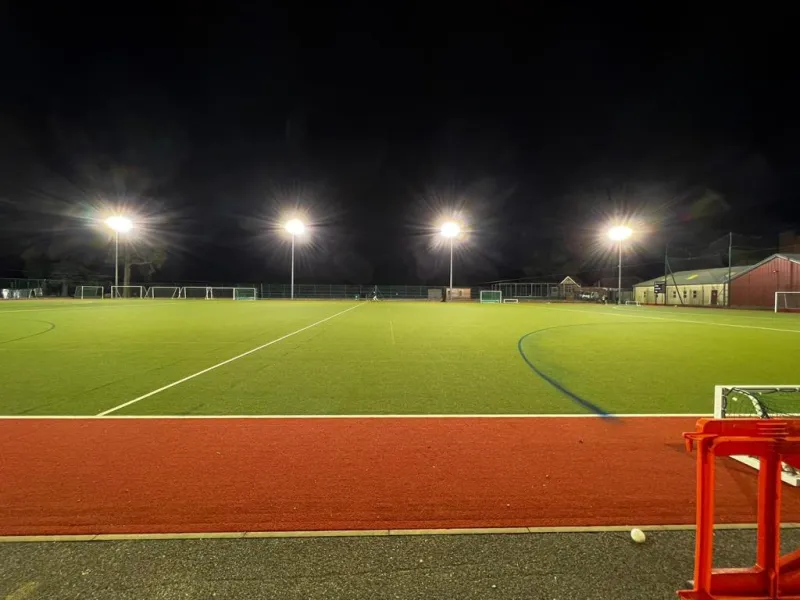
Photo: floodlit artificial turf hockey pitch night match players, via www.directsportslighting.co.uk
At 8.40pm on a Friday evening in Slough, the floodlights hum above a Division One fixture that, five years ago, would have been played at 2pm on a Saturday. In the car park, a minibus idles. On the balcony, a handful of supporters cradle paper cups of tea. The hockey is good. The timing, however, is new — and it is not unique to Slough.
A review of fixture lists across the men's and women's league pyramids reveals a pattern that fixture secretaries have been discussing for some time: the Saturday 3pm slot, once the default rhythm of English club hockey, is ceding ground to Friday and midweek evenings. The shift is neither sudden nor loudly announced. It is happening fixture by fixture, club by club, under lights that were installed for training but are increasingly earning their keep on matchdays.
The Numbers Behind the Move
Speak to enough fixture secretaries and a common thread emerges: availability. Weekend fixtures that once required little negotiation now demand weeks of diary management, as players balance shift work, zero-hours contracts, family commitments and — increasingly — weekend jobs that simply did not exist a generation ago.
"We moved our second fixture of the season to a Friday night almost by accident," one Midlands fixture secretary told us. "We had a postponement, the pitch was free, and nobody wanted to give up a Sunday. We won 4–1, everyone stayed for a drink afterwards, and we've never looked back."
The practical drivers are easy to identify. Artificial turf pitches shared with football clubs face intense weekend demand, with hire slots at a premium between September and March. A Friday evening slot is often cheaper, more reliably available, and — crucially for clubs sharing facilities — less likely to be bumped by a rival booking.
There is also a quieter arithmetic at work. A Friday fixture means a Saturday free for those who play, umpire or coach across multiple teams. For clubs fielding five or six sides, spreading fixtures across the weekend and into Friday evenings reduces the annual scramble for pitch time and umpires alike.
What the Players Say
For younger members of the squad, the change is largely welcomed. A Friday evening fixture slots neatly around a working week, leaves the weekend untouched, and — as one National League player put it — "gives you a proper reason to go out on a Friday that isn't just the pub."
Others are less convinced. Players with young families describe the logistics of a 7.30pm pushback as considerably harder than a Saturday afternoon: childcare that runs late, long drives home on dark roads, and the knowledge that an early start looms the next morning regardless.
There is, too, the question of atmosphere. A packed Saturday touchline, with juniors watching from the fence and parents running the tea hut, has a texture that a sparse Friday crowd struggles to replicate. Several club officials admitted privately that floodlit fixtures draw better hockey but thinner support.
The Fate of the Post-Match Tea
No discussion of the traditional matchday is complete without the post-match tea — that most English of institutions, in which two sides settle their differences over sandwiches and a strong brew. Its fate under the floodlight economy is genuinely uncertain.
Some clubs have adapted admirably, shifting teas to a compact Friday format or decamping to the clubhouse bar. Others have simply dropped the practice for midweek fixtures, and there is a quiet anxiety among longer-serving members that something intangible is being lost. Hockey has always prided itself on its sociability; whether that sociability survives a 9.45pm final whistle on a cold February night remains an open question.
A Lifeline, Not a Requiem
The evidence, on balance, suggests that floodlit fixtures are less a rejection of tradition than an accommodation of modern life. Clubs that have embraced Friday and midweek hockey report improved availability, fewer conceded fixtures and better retention among players in their twenties — precisely the demographic that club committees across the country are struggling to hold on to.
The traditional Saturday afternoon fixture is not disappearing. It remains the anchor of the league calendar, and rightly so. But the floodlight economy is here to stay, and the clubs thriving in the coming decade will be those that treat it not as a compromise but as an expansion of what English club hockey can offer — more hockey, for more people, at more times of the week.
The tea, one suspects, will endure. It may simply be served a little later.